
Get To Know: Gracie Broom, founder of Reporti

Gracie Broom is the founder of Reporti, a safety tech platform helping clubbers, gig goers and other event attendees report incidents and connect with venue staff in real time, using just their phone and a QR code.
Reporti was inspired by Gracie’s background as a designer, her love of nightlife, and her commitment to giving people a voice in spaces where they can be hard to hear (both literally and figuratively).
We sat down with her in London to hear about how good design can make late-night spaces safer, and the challenges of building a tech company from the ground up.
Hi Gracie, can you tell us a bit about how Reporti works and the thinking behind it?
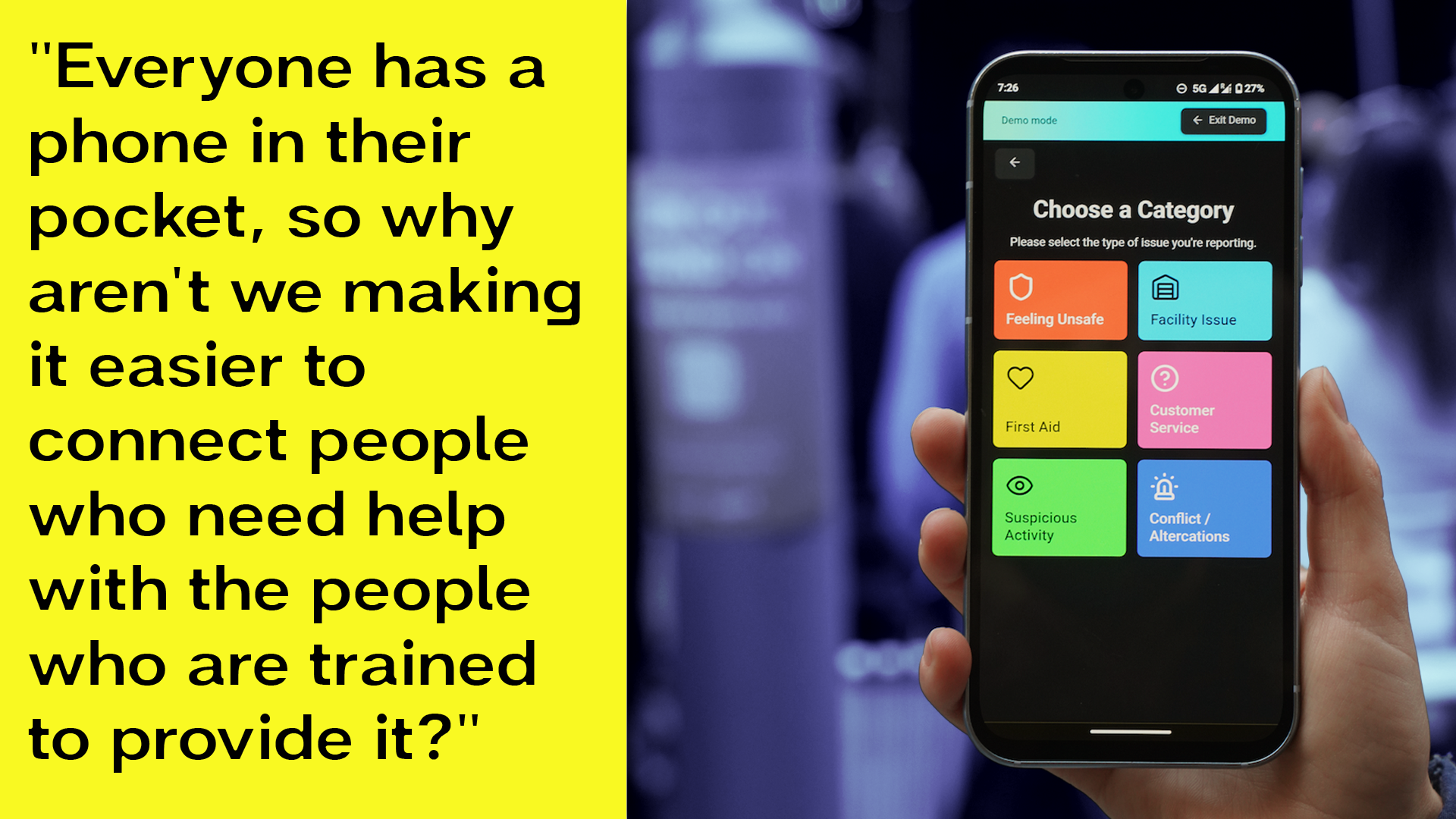
Reporti came out of several years of research into public safety, live events and how people seek help in crowded spaces. We've built a platform that allows guests to discreetly report issues and contact staff in seconds, while helping venues better understand what's happening across their spaces.
A lot of the motivation behind Reporti came from speaking to people who didn't feel safe in those spaces. During my master's research in London, Tokyo and New York, I heard time and time again of situations where people wanted help but didn't know how to access it. That led me to ask: how can we make it easier for people to ask for help, and easier for organisations to respond effectively?
What inspired you to pursue that as a project?
I grew up just outside London, which meant spending a lot of time outdoors, going to parties in fields, but also having easy access to the city and everything it had to offer.
I love events: I love what they represent, the culture, connection, creativity and shared experiences. I worked behind the scenes at events, attended plenty more, and became fascinated by the way people come together in shared spaces. Looking back, I think those experiences gave me an early understanding of both the magic and the challenges of bringing people together in all capacities, which has influenced the work I'm doing now.
I spent around two years exploring safety, behaviour and public spaces through design research. In Tokyo I was working on creative installations within nightlife spaces. In New York I worked alongside organisations supporting survivors of domestic abuse and explored trauma-informed approaches to design and communication.
Around the same time, I experienced an incident on the London Underground that left me thinking about how we communicate safety concerns in public spaces. We already have services like 61016 for reporting issues on public transport, and yet at many events there was still no simple, discreet way to contact staff directly. That question stayed with me: everyone has a phone in their pocket, so why aren't we making it easier to connect people who need help with the people who are trained to provide it?
Obviously, being a founder can be challenging: what motivates you to keep going?
I love the variety that comes with building a company. No two days are the same, and that's probably what keeps me motivated.
One day I might be working directly on the product, the next speaking with venues, preparing for a pilot, building a pitch deck or working on a marketing campaign. I enjoy solving problems, but I also enjoy learning, and being a founder means you're constantly being exposed to new challenges, industries and perspectives.
One of my favourite parts of the job is being on site with venues and festivals, seeing how these spaces operate behind the scenes, speaking to teams and understanding the realities of keeping people safe in busy environments. Watching Reporti grow in those real-world settings and seeing how people interact with it is so rewarding.
Do you have any particular inspirations or people who’ve helped you?
One person I've really admired is Jesse Wilson, founder of Jubel. What I find inspiring isn't just the business itself, but the way he's helped create and define a category within an industry. As someone building a new type of technology within the safety space, it's encouraging to see people successfully introduce new ideas into established markets.
Through programmes at the Royal College of Art, Imperial College, the Roundhouse and various accelerator programmes, I've met some brilliant mentors who have been generous with both their time and advice. Building a company can be quite isolating at times, particularly as a solo founder, so having people you can call when you're facing a challenge is invaluable.
What's one thing about your industry that’s due for a rethink?
I think the expectation that every technology product should be built and scaled at extraordinary speed is worth challenging. AI has made prototyping and experimentation much more accessible, which is fantastic. We've benefited from that ourselves.
But some products, particularly those connected to public safety, need careful testing, iteration and strong technical foundations. Moving quickly has value, but trust, reliability and thoughtful design matter too. Finding the balance between those things is increasingly important.
What's something that's considered cool right now that you think won't age well?
I'd probably say the notion that technology can replace the need to deeply understand people.
AI and vibe coding are incredible tools, and they've made it possible to prototype ideas and test concepts faster than ever before. But I do think there's a risk of believing that because you can build something quickly, you've automatically built something people actually need.
For me, the most valuable part of design has always been speaking to people, observing behaviour, understanding frustrations and uncovering the things people don't always articulate directly. That's where the best ideas come from.
The technology will keep evolving, and the tools will get better, but I don't think user research, empathy and spending time with the people you're designing for will ever become less important. If anything, as technology becomes easier to build, those human skills become even more valuable.
Where do you see yourself in 10 years from now? What would you like to be doing?
I'd love to still be working at the intersection of technology, public spaces and safety in some form. Of course, I'd love to see Reporti continue to grow and evolve. One of the things that excites me most is the opportunity to move beyond simply responding to incidents and towards helping organisations proactively understand and prevent them in the first place.
More broadly, I've always been fascinated by how people interact with shared spaces. Whether that's through technology, design, architecture or culture, I'm interested in the third spaces that bring people together and the role they play in our lives. As our cities and public spaces continue to evolve, I'd love to still be contributing to conversations about how we make them safer, more welcoming and more connected.
What do you think the main differences are between Gen Z and older generations?
I think every generation is shaped by the tools and circumstances they grow up with. For Gen Z, technology has always been there. We're connected to almost everything all of the time, which creates incredible opportunities but also a huge amount of noise and pressure. There's an expectation to move quickly, stay visible and constantly keep up.
At the same time, I think many people are starting to recognise the value of slowing down, building real relationships and spending time in physical spaces with other people.
I don't think it's necessarily about one generation being better or worse than another. It's more that we're all adapting to a world that's changing incredibly quickly.
Are you optimistic or pessimistic about the future?
I'm optimistic! We have access to tools, knowledge and opportunities that previous generations could only dream of. The pace of change can feel overwhelming at times, but it also creates huge opportunities to solve problems and improve people's lives.
What I find most exciting is that technology is becoming more accessible. More people can build, create and experiment than ever before. The challenge is making sure we're using those tools thoughtfully and for the right reasons.
I think the future belongs to people who can balance technological progress with a genuine understanding of human needs. If we can do that, there's a lot to be optimistic about.
And perhaps that's what sits at the heart of Reporti too. The goal isn't simply to add more technology to the world. It's to use technology in a way that helps people feel safer, more connected and more confident in the spaces they share with others.