
How Luxury Brands Can Learn From Westside Gunn
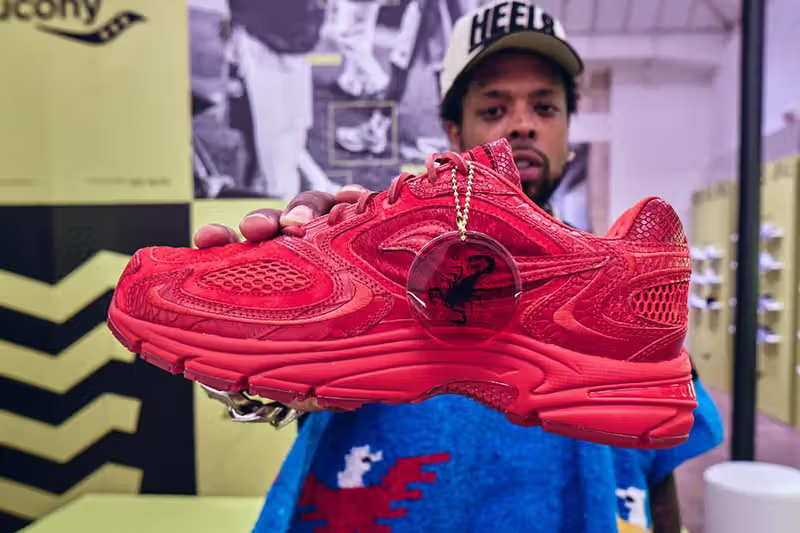
Over the past decade, since the seminal release of his album FLYGOD, the Buffalo-born rapper Westside Gunn (WSG) has become a singular force, completely redefining the concept of luxury within the confines of rap music, a vision he has masterfully woven into his forward-thinking approach to fashion and his deep, passionate love for the world of professional wrestling.
These three seemingly disparate worlds, which are gritty, visceral street rap, high-concept fashion, and the theatrical spectacle of wrestling, don’t just collide; instead, they exist in a carefully calibrated orbit around each other, each element contributing essential gravity and context to WSG's expansive and unique wider storytelling and narrative universe.
In this context, his independent label, Griselda Records, has evolved far beyond a music imprint; it has transformed into a kind of arthouse collective, a dynamic creative hub where the music released serves not just as entertainment but as a meticulously curated window into the dark, opulent, and constructed universe WSG has been building for years.
While he is certainly not the only rapper to successfully use the platform of hip-hop as a launchpad for broader artistic and commercial endeavours, A$AP Rocky, for instance, has successfully mastered this cross-disciplinary approach over the past fifteen years, few have managed to do so while maintaining such fiercely authentic origins in the underground hip-hop scene and then successfully navigating to work closely and conceptually with revered, global designers such as the late Virgil Abloh.

This unique narrative blending extends visually to his album artwork, which serves as a canvas for this high/low duality. His album artwork frequently pays direct, explicit homage to wrestling greats, a nod to the spectacle and high-drama of the ring, while simultaneously incorporating controversial figures from the annals of organised crime, bridging the gap between theatrical performance and gritty reality. By also reimagining Renaissance art, on Pray For Paris his albums signal a decadent form of rap in an overcrowded space.
Despite this often dark and archival visual content, the music is aspirational. A meticulously crafted soundscape of opulent samples, luxury brand references, and triumphant, almost spiritual declarations of overcoming adversity, transforming the grim reality suggested by the visuals into a blueprint for ultimate success.
Brands have collaborated with rappers for decades, recognising the immense cultural influence and reach these artists possess. However, what is critically important for luxury brands to grasp is that they still have a significant way to go in truly understanding and appreciating how artists such as Westside Gunn are actively building entire cultural worlds and self-sufficient aesthetics. Worlds that these brands should be eager to integrate into, rather than viewing the relationship as a one-sided opportunity for the artist to validate the brand. The paradigm must shift: the power and creative momentum now lie with the artist and their curated universe.

In keeping with the theme of play, Westside Gunn takes an experimental, almost avant-garde approach to his distinctive voice, his fashion sensibilities, and 4th Rope, the professional wrestling company he founded and oversees.
Westside Gunn's creative universe offers a critical lesson for luxury brands: the future of cultural relevance lies not in simple product placement, but in fearless, robust world building. By seamlessly synthesising the gritty reality of the street, the aspirational glamour of high fashion, and the theatrical drama of professional wrestling, WSG proves the power of bringing contrasting, even contradictory, themes together.
This high/low duality, executed with uncompromising authenticity, generates a deeply resonant narrative that brands should be eager to integrate into. His approach inspires a new paradigm where brands move beyond mere association and instead participate as integral partners in the complex, self-sufficient, and constantly evolving cultural worlds that artists have already meticulously constructed.