
If The System’s Rigged, What Does Winning Look Like Today?

- Surrounded by global economic and cultural upheaval, Gen Z’s ability to access traditional markers of success, from financial stability to luxury consumption, has been severely limited.
- Rather than complaining about it, they’ve been rethinking what winning looks like: often in irreverent, unexpected ways.
- For brands, the challenge is about widening access to these broader and newer notions of success, not clinging onto signifiers that feel increasingly irrelevant to how young people see the world.
If you’re a young person in the UK today, it can be hard to avoid feeling like you’ve been cheated. Our graduate unemployment rates remain some of the worst in Europe, while over a third of first-time buyers currently rely on the ‘bank of mum and dad’.
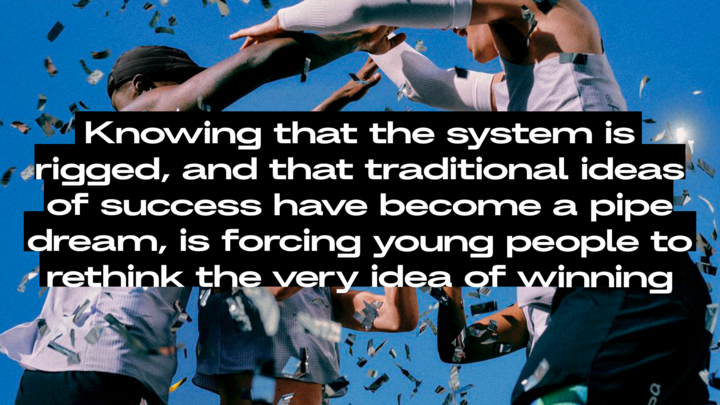
And yet, where millennials spent the 2010s wondering why things weren’t working out the way they’d been promised, Gen Z’s response has been grounded in realism. Knowing that the system is rigged and that traditional ideas of success have become a pipe dream is forcing young people to rethink the very idea of winning.
“We all feel the sense that the script we were sold has been upended,” argues the historian and author Dr Eliza Filby on a recent episode of The Rest Is Politics. Perhaps controversially, she suggests that “Gen Z have got it better than millennials”: not because their material conditions are any less insecure, but because young people were “never under [the] illusion” that life is a meritocracy in the first place.
According to Filby, where millennials were left “angry and confused” when they realised they’d been lied to about university, the job market and their financial stability, younger generations have rolled up their sleeves and got on with it.
Today’s pop culture is defined by that same lack of sentimentality, where the people at the so-called ‘top’ are being dethroned by those with a different kind of power. For decades, the Met Gala has signified a ‘Look mum, I made it’ moment for celebrities, accompanied by passionate Instagram debates over the outfits and their adherence to the year’s overall theme. But this year, deference was in short supply. Instead, influencers such as Matt Bernstein decided to report on the gala’s new honorary chairs, Jeff Bezos and Lauren Sánchez Bezos, and Amazon’s myriad violations of human rights.
Elsewhere, people like Tash LC and Cooly G (DJs with a smaller community of dedicated fans) posted jokey AI-generated images of themselves at the Met Gala, with captions saying things like: “Thank you to my glam team, to my family for the support, and all the fans that have got me here and believed in me.” Even my friend, a 24-year-old producer from south London who has conducted her own guerrilla reporting on the Met Gala every year I’ve known her, refrained from taking part this year because “it felt wrong amongst all the bad press and the outfits were rubbish anyway”.
Clearly, our collective frustration with the hypocrisy and injustice of celebrity is causing us to look elsewhere for inspiration. The connection to house prices might not be immediately obvious, but they’re rooted in exactly the same process: a generation realising that the game is rigged, and refusing to play by the same old rules.
This shift in focus signals something deeper about how people view success today, and who has cultural authority as a result. The rise of alternative influencers suggests that definitions of success are broadening. No longer is it a linear and one-dimensional route upwards; there is greater scope for alternative visions of success and alternative visions of winning.
It’s through these subversive ideas of winning that brands are making headway. One such imprint is ASICS, a brand that was once considered the dorky “dad” shoe but suddenly became one of the hottest new trainers on the block. With a following of 1.5M on Instagram, the sports brand takes a more holistic approach to winning, one that centres the joy of movement over productivity and being the “best”. Its recent ‘Get the Glow’ campaign proposes that “just 15 minutes of movement can help lift your mood”, creating a more obtainable and inclusive image of achievement in comparison to other brands.
ASICS also celebrates non-traditional stories of success, such as Ade Okojibe: “After years of not being able to walk, he doesn't take a single step for granted," reads an Instagram caption on the ASICS front runner. “Now he runs and leads others to do the same. He’s the living proof that movement isn't just exercise. It's a reason to be grateful and feel free. This is what works for him. What works for you?”
The message: you don’t have to be the fastest runner to be a winner; success comes in many shapes and sizes, depending on your personal circumstances. This tone of voice sits in stark contrast to Nike’s recent “Runners welcome, walkers tolerated" campaign, displayed during the Boston marathon and London parkruns, which faced extreme criticism (so extreme it was eventually taken down) by running communities who felt the brand was "pace-shaming."
This controversy reveals what is at stake when brands don’t listen to their audience. What Nike failed to see is that winning today is not what it used to be: a trend that we’ve seen across ON ROAD’s research, and our conversations with our network, over the last few years. For young consumers who are facing a very different world (economically, socially and technologically) from their forebears, a more inclusive vision of winning is necessary: one that takes into account the difficulties they are facing, and what’s lost when success is given only one meaning.
Because what Gen Z has that millennials didn't is the foresight to know that when success is monolithic, it leaves many of us behind. We know that what we were promised was unrealistic, and our way of coping with that is by being cautiously optimistic about the future; resetting the standard for aspiration and finding happiness in what we have.
And we expect brands to do the same. Not to tell us we can reach the top, or to tell us we can’t, but to imagine what success might look like, when we allow more people to access it.
Want to discuss this in more detail? Get in touch for the latest freeinsights from our ongoing webinar series on the future of culture: info@onro.ad