
Play First: How London’s creative collectives are preserving youth culture through unity and co-operation

There is a reason that ‘community’ is such an overused term. With so many facets of modern life working against the bonds of social cohesion, young people today, in the UK at least, must actively work to find a sense of ‘belonging’, whether that’s online or in-person. As the well-known trend-forecasting group K-hole said in their 2014 ‘Youth Mode’ report:
“Once upon a time people were born into communities and had to find their individuality. Today people are born individuals and have to find their communities.”
But times have changed since 2014. And while this desire to find one’s community has not disappeared, there are an increasing number of reasons to look beyond its confines, and find what might be described as ‘unity’.
This is nowhere more evident than in politics, where we consistently see the factionalisation of the left, with in-fighting between communities effectively on the same side of the argument, preventing us from taking on a common enemy. But it is also evident in youth culture, where a sustained lack of funding and erosion of infrastructure has left many creative communities – spanning music, art, photography, film, fashion and more – suffering.
Unfortunately, this has led to a perceived decline in cultural output from cities like London and Manchester, previously known for their vibrant and prolific creative innovation. And while there still is much incredible art and music coming out of the underground, many would argue that young people today do not produce the same volume of work as those of previous generations (when the YBAs were at their height and jungle, garage, grime, UK Funky and Afro Swing evolved in the span of about 20 years).
But it is not the case that young people today are ‘less creative’ than our forebears, rather that we are fighting an even harder battle to access the space, time and resources needed to create, which is why you see so much more innovation today coming out of cities where the rent is cheaper and the working hours are fewer. This was perhaps at most obvious just post Covid, when even the few nightclubs, youth centres, and studio spaces that did still exist shut up shop, with many struggling to return.

But youth culture persevered, as youth culture always does, with artists, designers, musicians and filmmakers meeting up where they could and making do with what they had to continue creating what they needed. What we have seen as a result of this, is a unification across cultural and community borders. As Hector from New York told us during our ‘Future of Cool’ webinar: “One flame giving light to another, never lost no light”. In other words, by coming together and helping each other shine, everyone succeeds.
This is most evident in the proliferation of creative collectives that have popped up across London alone, where the goal is not to nurture just one scene by providing a space and platform for it to thrive, but to create the opportunity for multiple communities to unite and thrive by sharing ideas, perspectives and resources. Ultimately, in times of scarcity, co-operation and solidarity are the best ways to ensure everyone is fed, and that means abandoning the traditional borders that might have kept different creative scenes in their boxes, to create a more fluid cultural scene.
“London’s creative scenes are crossing over more because they have to,” explains Peter, the founder of Sonder Haus collective. “Spaces are disappearing, funding is tight, and everyone’s realising you can’t just stay in your own niche bubble anymore. Music needs art. And art needs music. And communities need programming. So naturally things are blending.”
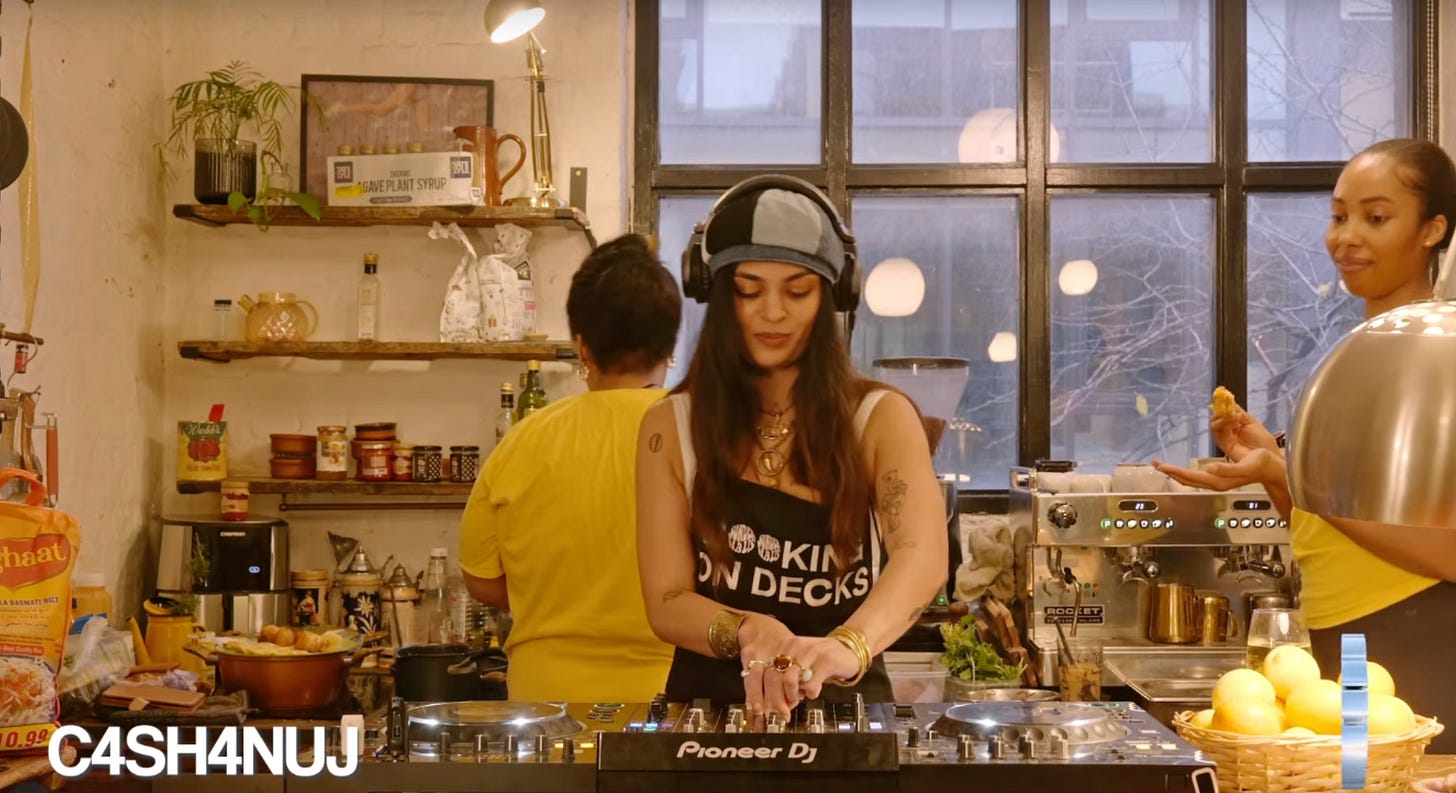
At Sonder Haus this “blending” of different scenes can look like anything from ‘Cooking on Decks’ a Sunday event where DJs play in a kitchen while chefs make brunch to ‘Pole & Pencil’ a night of pole dancing and still life drawing. “Honestly, that’s where it gets interesting,” says Peter. “When someone comes for a games night and ends up in a conversation about film, or comes for painting and stays for live music. That crossover creates depth.”
For Ethan, the co-founder of Five Fold (another inter-disciplinary community with a greater focus on curated events), it is through this unification of creative communities that young people are shaping how culture is being laid out for the future.
“By aligning our values and efforts, we are creating the future we want and need,” he tells me over Instagram. “We want to be able to make, we want to have places to be together, we want to feel safe and respected. Basically, we need London to work for us.”
Which is what he is trying to do (alongside his friend Flora) with Five Fold. “We’re trying to unify creative people by encouraging them to work together and speak to one another. If we want more unity we need to resist (as best we can) participation in the existing structures which aren’t serving us.”
It is with this resourceful and co-operative spirit that young people are coming together (again) in London and beyond. Thinking beyond boundaries to create experiences that exceed the expectations of one practice by taking it in new directions. But also by working together and creating lines of communication across communities, to build a better future for creativity as a whole.
When we look back in history to times when this has happened before, from the Bloomsbury Group to the Harlem Renaissance, it is precisely because of their inter-disciplinary nature that these moments were so creatively fruitful and culturally influential. Because it is at the intersection of sub-cultures that true innovation is found, when one craft inspires another, which can only give us hope to think of the creativity we might see in the coming years.