
Play First: When sincerity goes too far

Last week saw one of the most highly talked about celebrities of the past year take a serious fall from grace. In true, meme-fied style, Timothée Chalamet got chewed up and spat back out of the internet, and I didn't mind it.
It’s funny because throughout our research project and editorial series looking at what cool means to young people today, Timmy consistently got referenced as a figure who epitomised the newfound respect for sincerity that is shaping youth culture.
“I feel like there’s a movement coming up where effort is really, really cool and effort is really, really sick. Like the Marty supreme ad, you know, that’s a perfect example because Timothée is using every tactic in the books to push his film,” 26-year-old Hector from New York told us when we asked him who represents ‘coolness’ today.
Essentially, to most of the young people we spoke to, Timothée’s shameless “pursuit of greatness” was seen as admirable, from his bold acceptance speech for the Screen Actors Guild best-actor award in early 2025 (where he effectively declared he would win the Oscar in 2026) to, as Hector mentioned, his extensive self-promotion run for the Marty Supreme film. As they saw it, in the world we live in today, hustle is mandatory, it’s a part of life, and so we may as well be honest about that and not pretend like things come easy – because they don’t.
At least that’s what we heard a few weeks ago. But, it seems there might be limits to the sincerity we want to see from those we look up to, and when the scales tip too far, the consequences are ugly.
It all started when a video of Timothée in an interview with Matthew McConaughey went viral. In it, the then-Oscar-nominated actor declared that he was happy not to be working in “opera or ballet” because they are dying arts that no one cares about anymore. Perhaps unsurprisingly, the drawbridges instantly came up as people from both scenes in question rushed to their beloved crafts’ defence.
If I’m honest, I thought the levels of backlash were a little over-the-top and the idea that Timothée lost out on the Oscar because of them is wrong (the voting had already closed before the video went viral) and diminishing to the eventual winner Michael B. Jordan’s standout performance in Sinners. (The suggestion that Michael B. Jordan won because of Timmy's mistakes is “frustrating at best and, at worst, an indication of a racist industry that refuses to believe a Black man could have won on merit alone,” writes Kathleen Newman-Bremang in Refinery29).
However, Timmy definitely picked a fight with the wrong crowd. Perhaps I’m making stereotypes myself here but fans of ballet and opera (what is to them “high art”) don’t tend to brush things off lightly. And thus Timmy entered The Dolby Theatre that weekend with his tail already between his legs and probably prepared for the inevitable leg-pulling that would come from Oscar host Conan O'Brien. What he could not prepare for were the levels of leg-pulling that would come for him online when he eventually (rightfully) lost the Best Actor award.
The internet did what the internet does best and the ensuing memes were pretty funny, with many pointing out that the Oscar loss was the most Marty Supreme result there could have been.
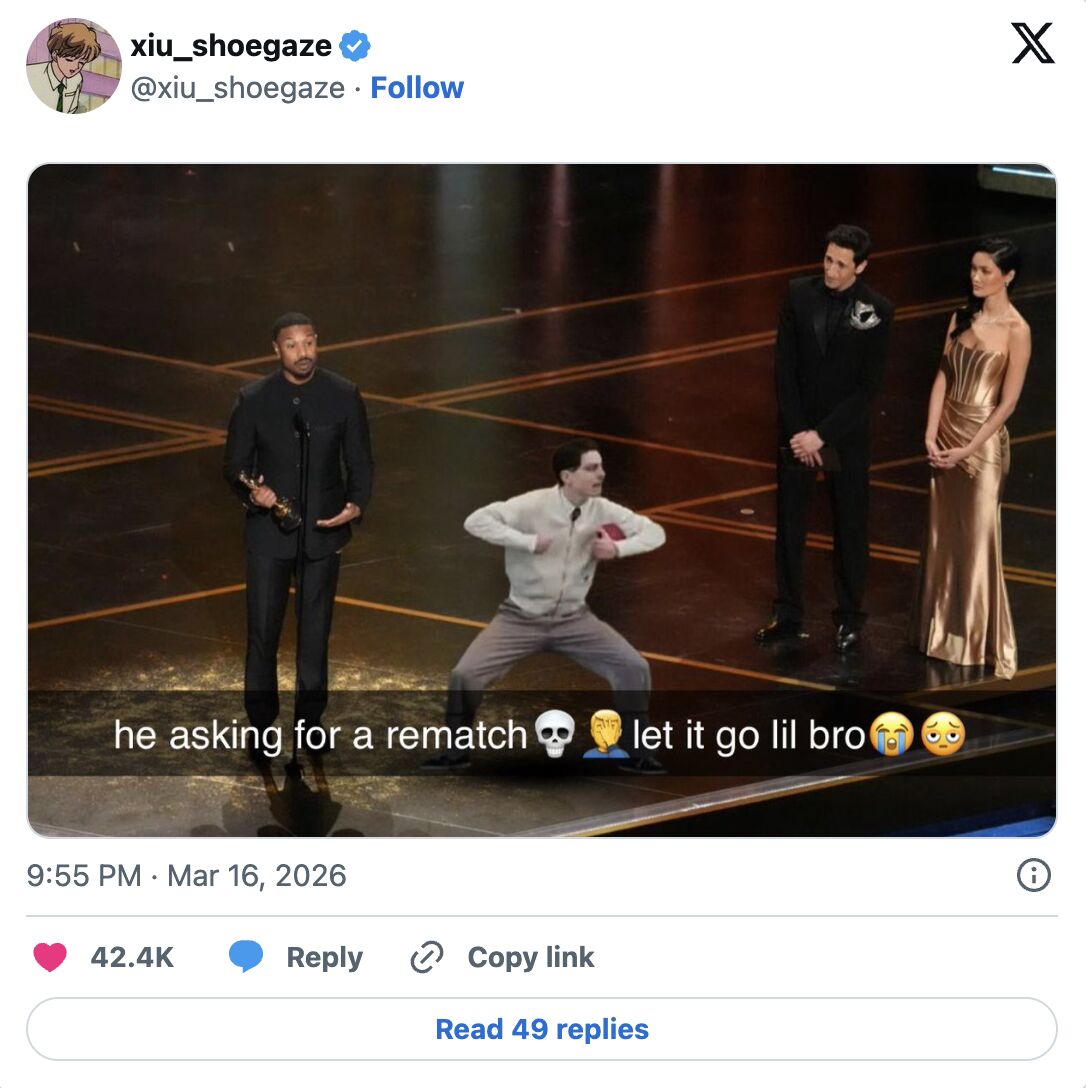
One thing was clear: Timmy was no longer the internet’s golden boy. He was no longer the ideal ‘soft boy’, the arthouse Frenchy who reads books and gets nervous in interviews. Instead, he was an arrogant jock-like figure who had consistently overestimated his own potential in interviews, tried embarrassingly hard to get people’s attention and, ultimately, lost sight of who he originally was (or in other people’s minds, showed us his true colours).

Very quickly, Timmy’s unbridled ambition didn’t seem so cool anymore. In fact, it felt like the internet was pleased to see him lose, not least because Jordan deserved the win more, but also because Timmy had been so bold to think he did. His tactics that had been praised for their effort and forwardness, were now being ridiculed and mocked. Despite everyone’s assertion that worrying about being cool was not cool anymore and being openly cringe was in, had Timmy gone too far? “Movie marketing is trying to be passive, trying to be chic,” Chalamet says in the fake Zoom call. “We’re not trying to be chic.” Had it ultimately backfired?
And would we have thought the same if he had won the Oscar? Because his unconventional, viral marketing campaign was a success, pushing an unreleased, original drama by an indie production house (and one about ping-pong no less) into the limelight, to compete against films with far higher budgets. Timmy had a far greater emotional connection to this role compared to films such as Dune or Wonka. It was a film he truly believed in, and for that you have to respect it.
So where did he cross the line? It felt like he still had people on his side when the fake A24 Zoom call was released. The EsDeeKid video dropped at Christmas gained widespread approval. And the Nahmias x A24 ‘Marty Supreme’ jacket sold out instantly at both NYC and London pop-ups just a few weeks ago. Right up until the Oscar weekend, it felt like people were rooting for Timmy.
Or maybe it didn’t. Maybe the ballet-and-opera-are-dying-saga was the straw that broke the camel’s back and actually just confirmed something we had all been thinking for some time, but no one had been brave enough to say yet: that the whole self-promo stint was getting a bit too much.
Meanwhile, Jordan’s own “pursuit of greatness” over the years has been steady and modest. He, too, is not afraid to speak about the dedication and effort he has put into his job and the years of sacrifice and hard work that have led him to where he is today, particularly as a Black man. But he never once publicly predicted his own Oscar win. And if he had, would MBJ be afforded the same grace that Timmy was in 2025? Or are there limits to who can and cannot be cringe and arrogant without criticism?
The two actors should not be compared. Michael B. Jordan won because Michael B. Jordan was better. He played a far more complex role (or technically two roles) that sparked cultural conversations and saw the actor learning a period dialect for the film. This is the kind of skill that earns respect and recognition from fellow actors.
And anyway, Timmy’s ambitions to receive the Best Actor award at such a young age (30) were a little unrealistic from the get-go. Most previous winners have been 40 or older, from Cilian Murphy’s win for Oppenheimer in 2024 at 47 to Will Smith’s win for King Richard in 2021 at 53, Leonardo Di Caprio at 41, Denzel Washington at 47, the list goes on. The suggestion being that Timmy was likely never properly in the running for the Best Actor award because there is an expectation that you must have years worth of training, hard-work and experience to be worthy of the accolade.
Maybe there is a lesson here. That sincerity and hustle culture have limits for Gen Z. And while we appreciate those who are open about their grind and what it takes to be successful in the world today, these displays must come with a level of humility and, at the very least, respect for those who are also on the same path. Timmy may have lost this time round, but now he is once again the underdog. Maybe if he sets his sights a little lower, and plugs away with a little more self-awareness, he can win back our hearts and regain his footing in the eyes of the cold, harsh internet.